Rebuilding Interstellar Through Typography
When I first encountered the prompt to convert Interstellar into a habitable micro-city engineered from its text, I was instantly captivated. The idea of translating a book’s motifs into architectural elements—towers, bridges, plazas—and mapping circulation paths from sentence flow felt like a unique challenge that blends literature with visual design in an unexpected way.
The foundation for this transformation was the hardcover, imagined as a solid slab anchoring the entire city. Page edges became stepped terraces, inviting the eye to wander upward, while the gutter formed a central canyon that naturally divided the urban landscape. This setup gave the scene remarkable depth and structure.
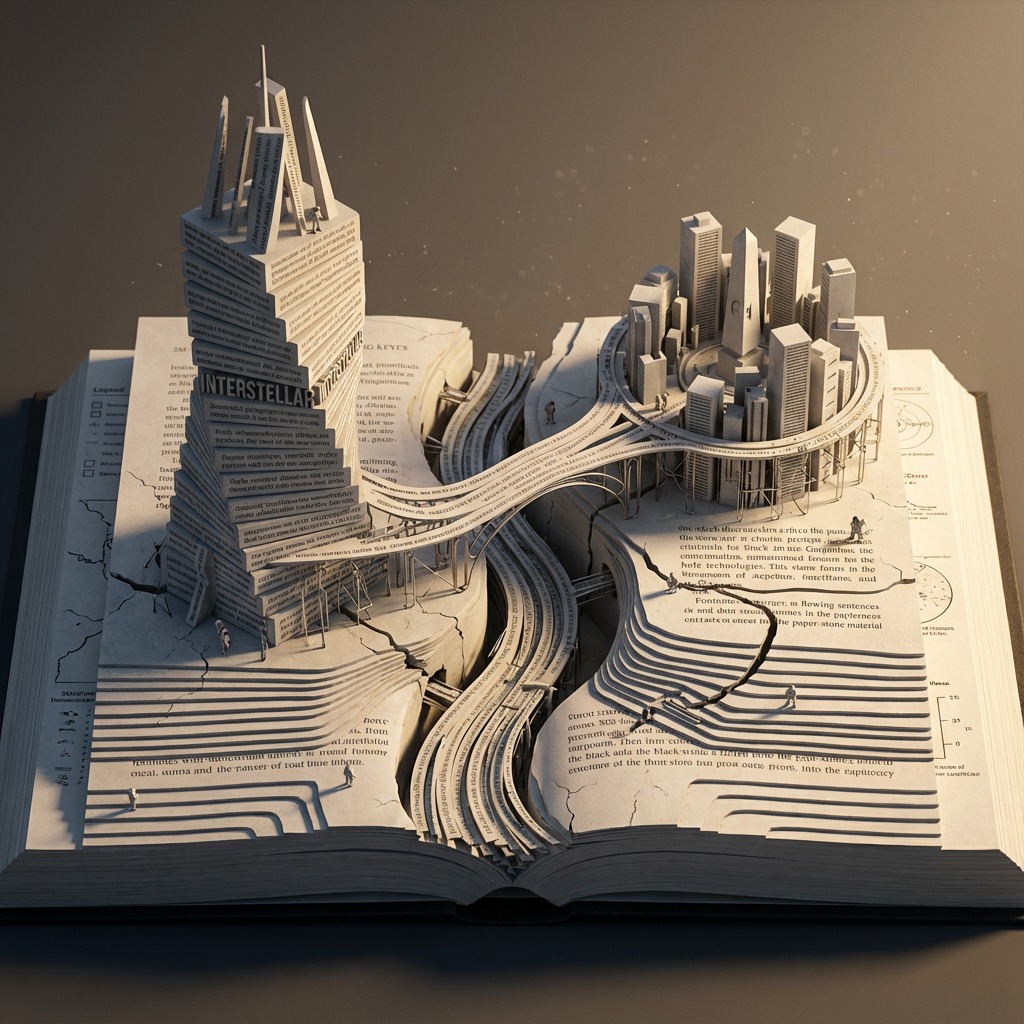
Paragraphs morphed into monolithic buildings, their blocky shapes reminiscent of brutalist architecture but crafted from “paper-stone” textures. Italics sprouted as slender spires piercing the sky, and drop caps stood as imposing obelisks marking key entrances. I loved how footnotes transformed into subterranean tunnels beneath the surface, adding an underground complexity.
To enhance realism, I added scale figures and scaffolding made from paper clips, which brought a playful yet tangible sense of construction. Hairline cracks in the ink “stone” and fine dust particles created atmospheric perspective, lending the scene a golden-hour glow. Long shadows fell dramatically, emphasizing the relief of the typography-turned-architecture.
The final image had a cinematic quality with a tilt-shift effect, shot at a 90mm focal length to capture ultra-clean silhouettes. Rendered in Unreal and Octane, the high displacement mapping gave the paper-stone hybrid a tactile feel that’s both futuristic and grounded.
This experience opened my eyes to how text-to-image prompts can push creative boundaries far beyond flat illustrations. By interpreting the prompt’s rules literally and thoughtfully, I discovered new ways to fuse storytelling and design.
You can find the full prompt here: ✨Prompt✨
For anyone interested in exploring this further, I recommend experimenting with AI image generators that support detailed architectural renderings. Adjusting prompts to include lighting conditions and material textures can dramatically improve results in text to image workflows. Avoid vague language; specificity in motifs and structural elements makes a big difference.
Overall, this project was a fascinating dive into the potential of AI for visual creation, inspiring me to approach book prompts with an architectural mindset next time.