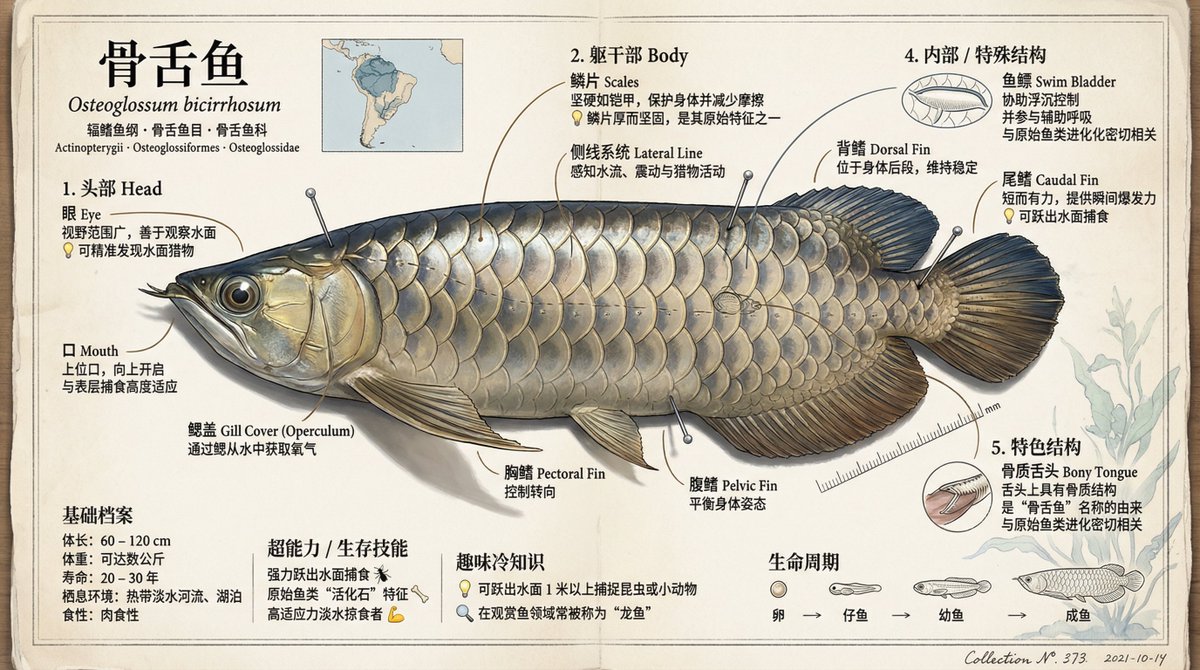
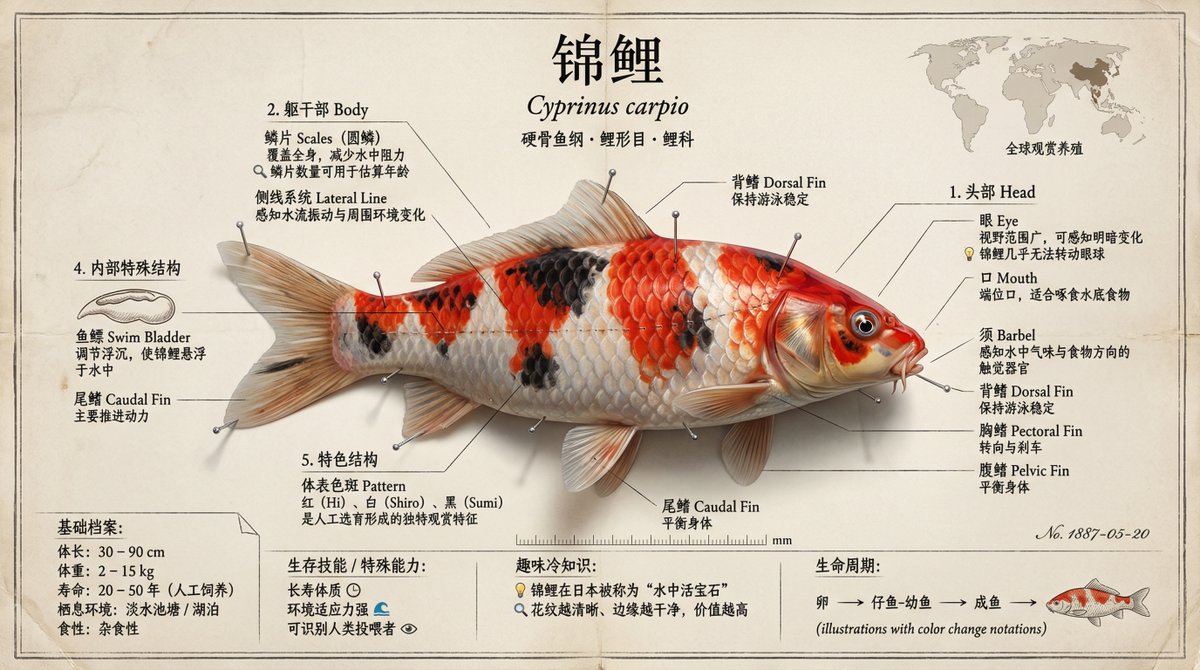
Inspired by the beloved Animal Crossing museum exhibits, I embarked on creating a fish specimen AI image that feels like an actual museum display. The goal was to produce a natural, scientifically rich, and visually captivating infographic focusing on a single representative fish species—imagine a giant tuna or a clownfish—laid flat on textured paper, as if pinned by a 19th-century naturalist.


You can find the full prompt here: ✨Prompt✨
The real challenge was capturing the physical presence of the fish specimen itself, not just a photo within a photo. The fish needed to occupy about two-thirds of the frame, lying flat in a strict top-down view. Soft, natural light from above casts delicate shadows beneath the fins and body edges, emphasizing the subtle texture of scales, the moist gleam on the eye, and the translucent fin membranes. Tiny silver pins pierce through key points like the dorsal fin and gill cover, pressing gently into the off-white paper beneath, complete with visible pinholes and faint indentations. This detail adds an authentic, tactile feel that separates this from typical digital illustrations.
Around the specimen, radiating annotation lines connect to neat text boxes explaining 6–8 anatomical features, each labeled in both English and Chinese. These include the eye with notes about its color vision, the mouth shape linked to feeding habits, the protective and hydrodynamic scales, and the lateral line that senses water movement. The fins are highlighted with their roles in balance, steering, and propulsion, while internal structures like the swim bladder or skeletal contrasts appear as subtle callouts. Every label combines simple, child-friendly explanations with fun facts marked by icons, making the science approachable and engaging.
The top section sports an elegant title in a serif font naming the fish in Chinese, with the italicized Latin name beneath and classification details. A tiny world map highlights its natural habitat, while a sidebar lists vital stats—length, weight, lifespan, diet, and habitat type—along with 2–3 unique survival skills illustrated by charming icons, such as camouflage or swift swimming. At the bottom, a simplified life cycle diagram shows stages from egg to adult, emphasizing growth changes.
The entire layout evokes a vintage scientific notebook, with warm ivory paper (#F8F6F0), faint paper fibers, and subtle aging marks. Annotation lines are drawn in muted brownish-gray (#8B7355), labels in deep blue-gray (#2C3E50), and highlights in antique gold (#D4AF37). The pins shine in silver (#C0C0C0), harmonizing with the natural palette. The typography blends handwritten notes with refined print fonts, reinforcing the hand-crafted feel.
This project taught me several image generation tips: specifying lighting direction and shadow softness is crucial to avoid flatness; requesting physical pins and paper texture adds realism; and balancing scientific accuracy with simple language makes the content accessible yet credible. A common prompt mistake I had to fix was the AI initially generating fish photos instead of specimens pinned on paper—clarifying "real, physical specimen pinned flat on ivory paper with visible pins and shadows" made all the difference.
For creators curious about how to use prompt adjustments, I recommend iterating on lighting and detail level, and emphasizing the 2D physical plane concept repeatedly to avoid 3D or photo-in-photo results. This approach works wonderfully for educational visuals, museum exhibit recreations, or stylized natural history content.
Overall, merging artistry with scientific detail in a museum-style fish specimen AI image was incredibly rewarding. It feels like peering over a naturalist’s shoulder as they carefully document underwater wonders, blending history, biology, and modern AI image generation techniques.
Check out related tools like the AI image generator for crafting your own natural history visuals, and explore more about text to image workflows or becoming an AI art creator. The possibilities for combining science and creativity with AI image generation are truly exciting!