When I first encountered the idea of visualizing a Large Language Model (LLM) not as a mere algorithm but as a tangible, cinematic artifact, I knew I had to dive into it. This prompt challenged me to imagine AI through a cyber-physical lens, using the "3D Realistic Deconstruction" framework. Instead of human features, the AI was rendered as an exploded digital brain made of silicon, glass, light, and data — a true tech symphony.
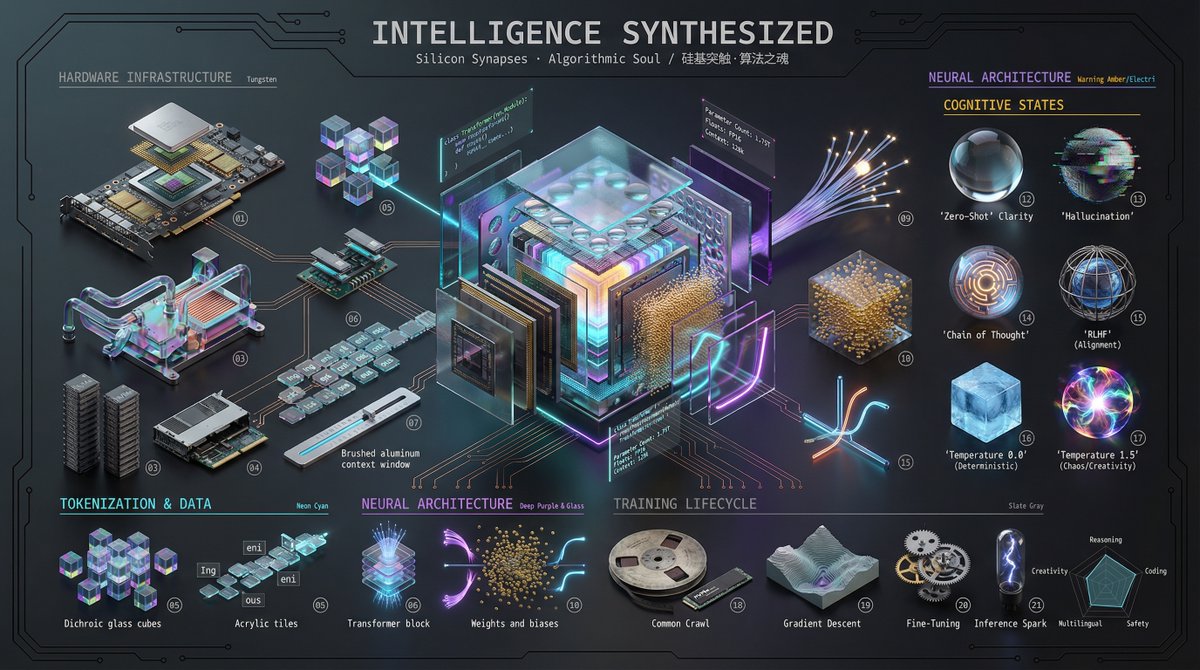
The core of the visual was this rigid "Knolling" layout, where 30 to 36 meticulously aligned components orbited the central "Core Model." It felt like peering into a futuristic server room, where every piece of hardware and software had a physical form and story. The hardware foundation featured tungsten and matte black elements: deconstructed GPUs with exposed silicon dies, gold pins hovering mid-air, and liquid cooling systems with iridescent fluid flowing through transparent pipes. The photorealism here was astonishing — you could almost feel the cold metal and see the microscopic dust on the cooling fans.
Moving into the "Tokenization & Data" zone, the abstraction became physical. Neon cyan cubes of dichroic glass represented embedding vectors, shifting colors as you moved. Translucent acrylic tiles broke down words into sub-tokens in a flowing stream, while a brushed aluminum sliding gauge marked the context window limit. This was AI language made visible, tactile, and vibrant.
Neural Architecture and Cognitive States
The "Neural Architecture" section, bathed in deep purple and glass textures, brought the AI’s brain to life. Transformer blocks appeared as layered glass panes and lens arrays; fiber optic cables glowing at their tips symbolized attention heads focusing light onto a single point. Billions of golden ball-bearings floated in a gel matrix, representing weights and biases — a mesmerizing dance of microstructures. Neon-lit glass tubes shaped ReLU and Sigmoid curves, making activation functions feel like glowing sculptures.
I was especially drawn to the "Cognitive State Gallery," where AI "emotions" were rendered as floating spheres with distinct characteristics: a flawless crystal sphere for zero-shot clarity, a glitchy voxelated orb for hallucinations, and a swirling plasma orb for chaotic creativity at higher temperature settings. These spheres felt almost alive, a poetic visualization of the AI’s inner workings and states.
Artistic and Technical Mastery
The entire composition embraced a cyber-physical realism aesthetic, reminiscent of high-end tech editorials or sci-fi prop design. Materials like anodized aluminum, chemically strengthened glass, and gold plating enhanced the authenticity. Lighting was key — volumetric ray-traced illumination and emissive materials made the components glow naturally, while laser-projected connection lines linked hardware and software elements. Details like fingerprints on glass servers and microscopic lithography lines on chips added an intimate touch, making the scene feel lived-in.
Typography combined monospace coding fonts with clean Swiss Sans-Serif, reinforcing the tech narrative. The background's dark charcoal gradient set the perfect stage, allowing the neon purples, cyans, and ambers to pop with cinematic flair. Technical annotations floated nearby, displaying code snippets, parameter counts, and specs, blurring the line between art and documentation.
This project transformed how I view AI — not as an abstract codebase, but as a sprawling, layered city of technology and intelligence. It’s a reminder that behind every line of code and every prediction lies a beautifully complex machine, worthy of admiration and wonder.
You can find the full prompt here: ✨Prompt✨
For creators interested in exploring similar visualizations, an AI image generator or AI art creator can help bring abstract concepts like these to life. Experiment with prompt adjustments to balance detail and clarity, and watch how your text to image experience evolves.