Reading Ivan Zhao's thoughtful article "Steel, Steam Engines, and the Infinite Brain" made me reflect deeply on where we stand in the AI revolution. Like many, I’ve been looking back at history’s great leaps—the Industrial and Internet revolutions—to glimpse what AI’s future might hold. Ivan’s perspective stands out for its clarity and depth.
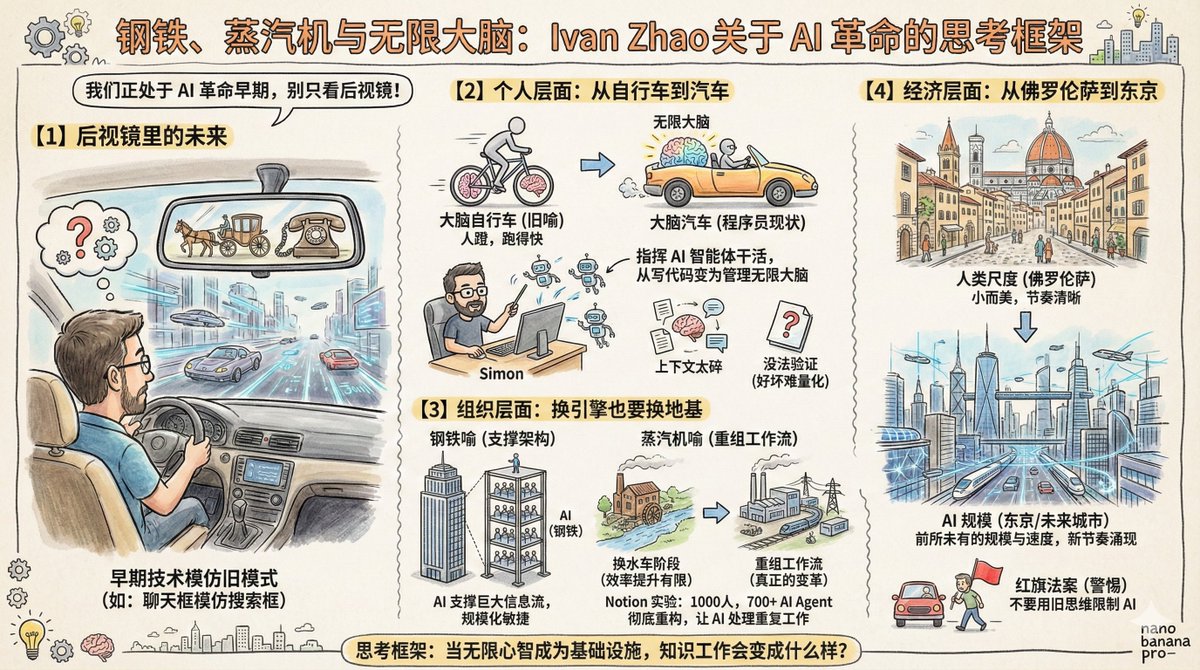
You can find the full prompt here: ✨Prompt✨
Looking Through the Rearview Mirror
One striking point Ivan makes is how we currently interpret AI through outdated lenses. Early phones were just "talking telegraphs," and movies were filmed stage plays. Today, AI mostly appears as a chat box mimicking the search bar. It’s a transitional awkwardness; we’re still trying to fit AI into old work modes rather than imagining new possibilities.
From Bicycles to Cars: The Programmer’s Leap
Steve Jobs once called computers "bicycles for the mind"—tools that amplify our capabilities but still require effort. Ivan shares how programmers have moved beyond that bicycle stage. His cofounder Simon, once a legendary coder, now orchestrates multiple AI programming agents like a conductor directing an orchestra. He no longer writes code himself; instead, he manages an "infinite brain" that works tirelessly in the background.
"He went from being a code writer to managing an infinite brain."
This leap feels exhilarating because it frees mental energy for higher-level thinking. But why is this transformation mostly limited to programmers?
Challenges Beyond Code
Two reasons: First, the context of programmers’ work is neat and centralized—code repositories are straightforward environments. In contrast, most people’s work is fragmented across Slack, emails, docs, and mental notes, making it hard for AI to grasp the full picture.
Second, outcomes in coding are objectively verifiable—errors stand out clearly. But judging a marketing campaign or weekly report quality is subjective and complex. To upgrade from bicycles to cars across roles, AI needs richer context and ways to validate work quality.
Organizational Shift: Steel and Steam as Metaphors
Ivan zooms out to companies, using steel and steam engines as metaphors. Steel allowed buildings to grow tall by replacing fragile brick walls. Similarly, AI acts as "steel" for organizations, supporting vast information flows and enabling nimble decision-making even in massive teams.
Steam engines replaced water wheels but initially didn’t change factory locations or workflows. Only when factories relocated closer to ports and workers, and machines got independent motors, did productivity explode. Right now, AI is like swapping water wheels for steam engines without rethinking workflows. Most companies still cling to old structures.
Notion itself experiments boldly by running 700+ AI agents in a 1000-person company. These agents handle meeting notes, internal queries, IT requests, and reports—freeing humans to focus on what matters. This is not mere efficiency; it’s organizational reinvention.
Economic Scale: From Florence to Tokyo
Ivan’s final zoom-out is breathtaking. Steel and steam reshaped cities from human-scale Florence to sprawling Tokyo—more chaotic but full of opportunity. Knowledge work today still operates at a "Florence" scale, limited by human communication and coordination.
But AI agents could enable "Tokyo-scale" knowledge economies with nonstop workflows and finely tuned human-machine collaboration. Traditional rhythms like weekly meetings may become obsolete. The future may sacrifice some clarity for unprecedented speed and scale.
A historical anecdote Ivan shares about England’s 1865 Red Flag Act—requiring a person to walk ahead of cars waving a flag—feels eerily familiar. Our current insistence on controlling every AI step might be the equivalent of that red flag. The real future is humans overseeing from above, not blocking the road.
Reading this, I realized how much we need to stop looking backward and start imagining new work paradigms. The infinite brain is not just a fancy metaphor; it’s a foundation for reinventing knowledge work itself.
For creators and professionals eager to embrace AI, Ivan’s article offers a thoughtful framework rather than neat answers. It invites us to rethink how we define productivity, collaboration, and scale in this early AI era.
For more on AI’s transformative potential and how to harness it visually or organizationally, explore tools like AI image generator and AI art creator. Whether you’re crafting visuals or workflows, understanding these shifts is key to thriving in the AI revolution.