Why I Tried Turning Text into a Comic Script
As a content creator fascinated by visual storytelling, I recently experimented with converting a dense, multi-decade scientific biography into a comic script. The goal was to capture complex ideas and a sprawling timeline with clarity and emotional depth, inspired by the narrative style of Logicomix. This process opened my eyes to how structured layouts and visual storytelling can breathe life into otherwise dry academic material.
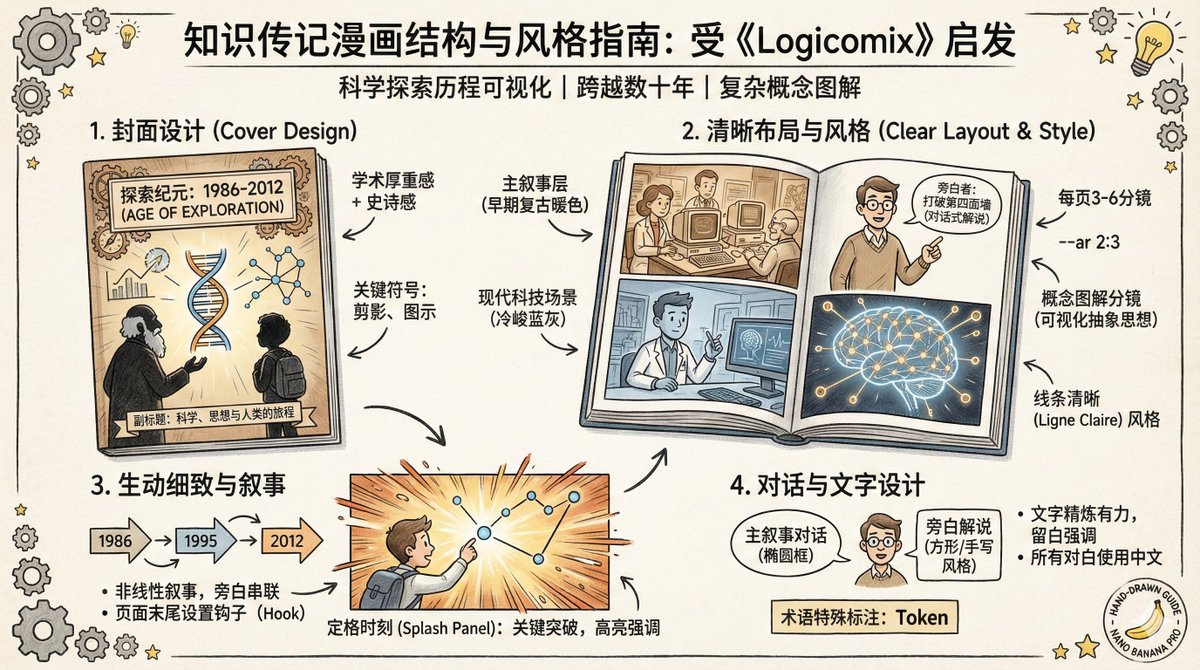
You can find the full prompt here: ✨Prompt✨
Visual Style and Narrative Layers
The comic adopts a Ligne Claire style—clean, uniform lines reminiscent of Tintin and Joost Swarte. Characters have distinct, cartoonish yet recognizable features, set against detailed, realistic backgrounds. This contrast helps focus attention while grounding scenes in their historical context.
Color plays a crucial narrative role: warm, sepia tones mark early periods, cool blue-grays represent modern tech scenes, and bright saturated colors highlight breakthroughs. This subtle color layering helps readers instantly identify shifts in time and mood.
A unique storytelling element is the use of "narrator" characters who break the fourth wall. These figures—often the protagonist in old age or key witnesses—move through panels, directly addressing readers with commentary or questions. Their dialogue appears in distinct, hand-written style caption boxes, visually separating them from the main narrative’s elliptical speech bubbles.
Page-by-Page Layout and Visual Details
Cover Design: The cover sets a scholarly yet captivating tone. It features a bold title in a serif font inspired by classic scientific journals, paired with a subtitle indicating the timeline (e.g., "1986-2012"). The composition includes silhouetted key figures and symbolic icons—like a glowing neural network—to hint at core themes. The color scheme blends deep blues with warm amber highlights, suggesting a journey from past to present.
Page 1: Six panels arranged vertically. The top half-page introduces the narrator in a close-up, softly lit, with a direct gaze. Next, three smaller panels show archival scenes: an old lab with vintage equipment (sepia tones), a handwritten manuscript, and a cityscape at dusk. The bottom panel is a wide, cinematic shot of the protagonist beginning their quest, colored in muted blues. This page ends with a narrator’s question in a caption box, prompting readers to reflect on the nature of discovery.
Page 2: Four panels focusing on early scientific challenges. One large panel (half page) visualizes a complex concept—a neural network—using glowing nodes connected by thin lines, set against a dark background. Smaller panels show the protagonist’s thoughtful expressions and interactions with colleagues, with carefully chosen angles: over-the-shoulder, close-ups, and medium shots to convey intimacy and tension.
Page 3: Features a splash panel spanning the entire page to emphasize a breakthrough moment. The protagonist stands triumphant, bathed in vibrant, saturated light breaking through a dark lab. Surrounding panels zoom into symbolic imagery: a gradient descent metaphor depicted as a traveler descending a glowing valley, surrounded by floating equations and graphs.
Subsequent Pages: The narrative jumps non-linearly across decades, with each page balancing 3–6 panels. Scenes are distinguished by era-appropriate costumes, hairstyles, and tech gadgets—early pages show bulky computers and analog devices, later pages sleek modern hardware. Lighting shifts from warm indoor lamps to sharp fluorescent and natural daylight, supporting the mood shifts.
Complex ideas receive dedicated "concept visualization" panels. For example, abstract theories are turned into metaphoric landscapes or glowing schematic diagrams, making them accessible and visually engaging.
Dialogue and Text Design
Dialogue uses elliptical speech bubbles with concise, impactful Chinese text, avoiding heavy exposition. Narrator commentary appears in square or handwritten caption boxes placed around or between panels. Scientific terms are highlighted with bold or colored fonts the first time they appear, helping readers grasp key concepts without interrupting flow.
Reflections and Tips on Using AI for Comic Creation
This detailed, imaginative layout serves as a perfect foundation for AI image generation. Each panel’s description includes enough visual detail—camera angles, lighting, character poses, color schemes—to guide AI tools effectively. Adjusting prompts based on these specifics helps avoid common mistakes like inconsistent character design or unclear scene moods.
For creators looking to turn stories into comics, layering narrative voices and using visual metaphors for abstract ideas can deeply enrich the experience. It’s also essential to plan page layouts carefully to maintain pacing and reader engagement.
If you want to explore AI-driven comic creation, check out these resources: AI image generator, text to image, and AI art creator. They offer great tools for bringing detailed prompts like these to life.