When I first came across the Nano Banana Pro prompt generated on @higgsfield_ai, I was intrigued by its promise of hyper-realism and perfect scale in a 3D isometric scene. The idea of inserting a fully realistic human—skin textures, pores, natural imperfections and all—into a circular base with carefully sized props felt ambitious yet exciting. I decided to take it for a spin.
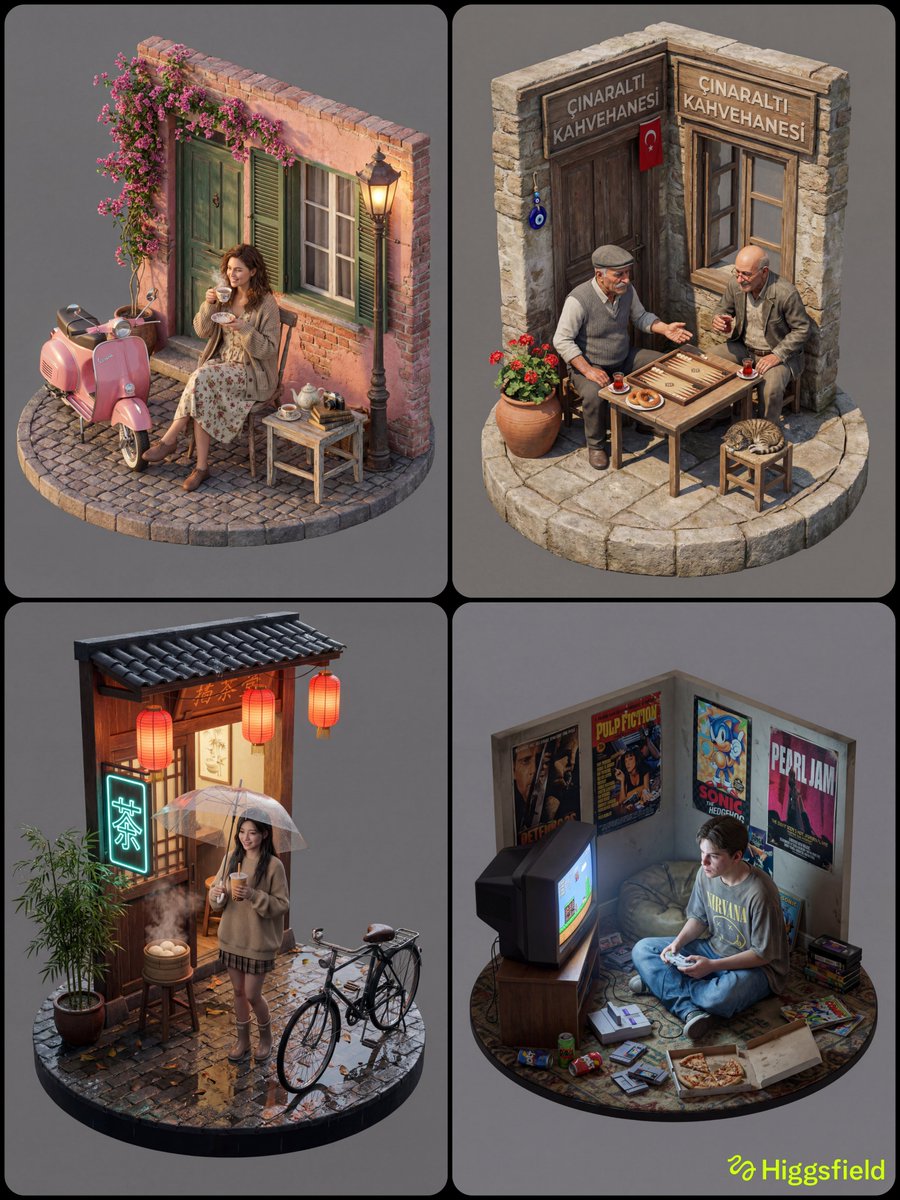
The prompt pushed me to think beyond cartoonish or toy-like renders, emphasizing living human skin with subsurface scattering that made the subject truly believable. Instead of a doll or figurine, this was a person who looked like they could step right out of the scene. The isometric wide shot ensured every detail—the circular base, the subject, and props like a vintage Vespa with gleaming chrome—was crisply visible and in perfect scale relative to each other.
One thing that really struck me was the environment setup. The weathered brick wall behind the subject wasn’t just a flat texture but had real depth and material authenticity, which added to the scene's grounded feel. The prompt’s insistence on Unreal Engine 5 style rendering with raytracing and global illumination made it possible to capture subtle shadows and highlights, pushing the realism even further. The deep depth of field kept the entire scene sharp, avoiding any distracting blur that could pull you out of the moment.
Working through this prompt taught me valuable image generation tips, especially how important it is to maintain correct proportions among subjects and props. I’ve seen many AI-generated images where scale is off—giant heads, tiny scooters—but here, the scale was spot on. This attention to detail elevated the visual storytelling, making the scene feel lived-in and authentic.
One practical insight was how the negative prompt helped avoid common pitfalls like cartoonish effects or missing limbs, which can often ruin an otherwise perfect render. By carefully balancing the positive and negative prompt elements, I got a clean, sharp image that felt more like a photograph than a digital creation.
If you’re diving into text to image creation or experimenting with an AI art creator, I highly recommend trying out prompt adjustments like these. It’s a great way to push your visuals to the next level and explore new moods and styles. For anyone curious about how to use prompt engineering to get hyper-realistic results, this is a solid example to learn from.
You can find the full prompt here: ✨Prompt✨