Floating Music Players in Augmented Reality
Recently, I experimented with a visually rich AI prompt that imagined a movie-quality augmented reality scene. The concept was to have numerous Spotify player interface cards orbiting a central person in a 3D spatial setup—each card strategically placed at different depths around the subject. The goal was to create a dreamlike visual where the music interfaces felt alive, tangible, and seamlessly integrated into the environment.
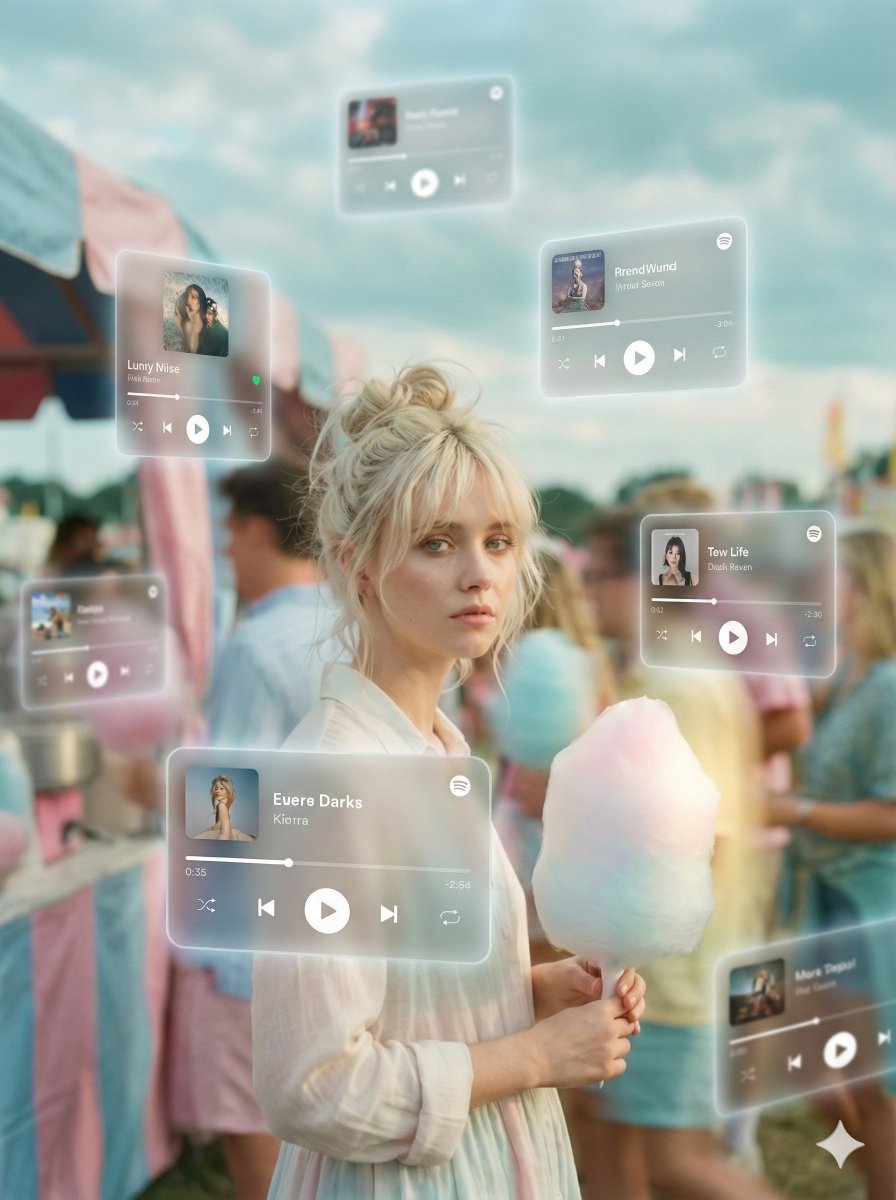
The prompt called for authentic UI elements from Apple Music and Spotify, including playback progress bars and recognizable controls, which gave the composition an immediate sense of familiarity. Each card was designed with smooth rounded edges and a translucent frosted-glass look, glowing softly with diffused luminescent borders. This subtle bloom effect interacted naturally with the ambient lighting, adding to the cinematic feel.
The color palette was intentionally cool-to-neutral, preserving rich shadow details and letting album artwork bursts add vibrant pops of color. Medium-high contrast and gradual highlight transitions created a polished, professional aesthetic. I loved how the prompt emphasized depth of field—cards closer to the viewer were razor-sharp, while those further away blurred gently, enhancing the spatial illusion.
One of the most challenging aspects was achieving a photorealistic central figure smoothly integrated into this augmented reality environment. The subject remained crisp and central, with some music cards partially covering them, which enhanced the immersive vibe.
From a practical standpoint, this experience taught me a lot about image generation nuances. The prompt’s specificity about UI elements and lighting effects helped avoid common prompt mistakes like flat layering or unnatural light sources. Adjusting the prompt to fine-tune the translucency and bloom was key to making the visuals feel organic rather than artificial.
For creators looking to explore similar concepts, this prompt is a great example of how to combine text to image technology with real-world UI references to produce a visually compelling story. Whether you want to depict music interfaces in AR or experiment with spatial compositions, paying attention to depth, lighting, and authentic detail makes all the difference.
You can find the full prompt here: ✨Prompt✨
Overall, this was a rewarding journey into blending digital music culture with augmented reality storytelling, and I’m excited to keep pushing these boundaries with my next projects using an AI art creator.